Screen Job Applications Faster With AI Shortlisting
10 min read
6 views
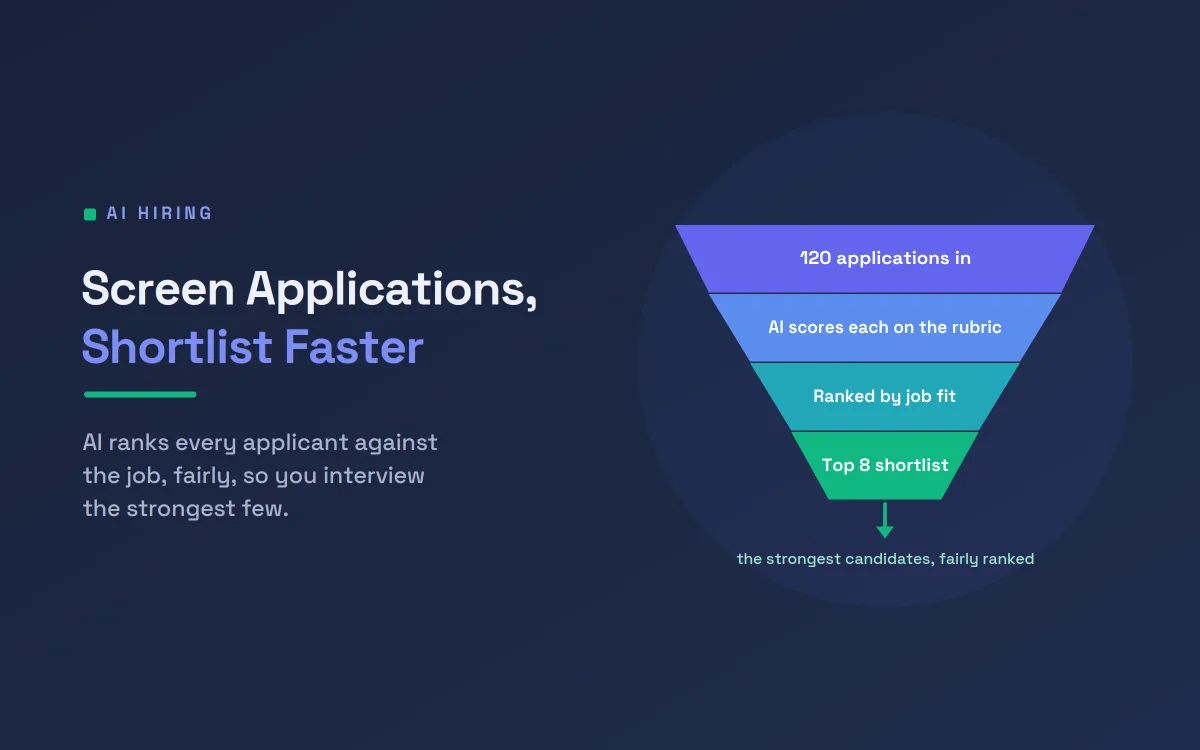
A hundred applications, and a few hours to read them
Post one good role and the applications pour in. A small team can easily face a hundred or more for a single opening, and somewhere in that pile are the few people worth interviewing. Reading every application carefully takes hours nobody has, so corners get cut, strong candidates get missed on a tired afternoon, and the process feels more like luck than judgement. This is where AI resume screening helps, by reading every application against the same job-relevant criteria and ranking them, so your team starts with the strongest few instead of a random sample. Used well, it makes hiring faster and more consistent.
The phrase "used well" carries a lot of weight here, and this article takes it seriously. Hiring is one of the most consequential and most regulated things a business does, and careless AI screening can quietly bake in bias and create real legal exposure. So this guide treats fairness and human oversight as the core of the design, not an afterthought. We will look at what AI resume screening should and should not do, how to build it responsibly, and the guardrails that keep it fair. The aim is a tool that assists your hiring team, never one that decides for them.
Score the job, not the person
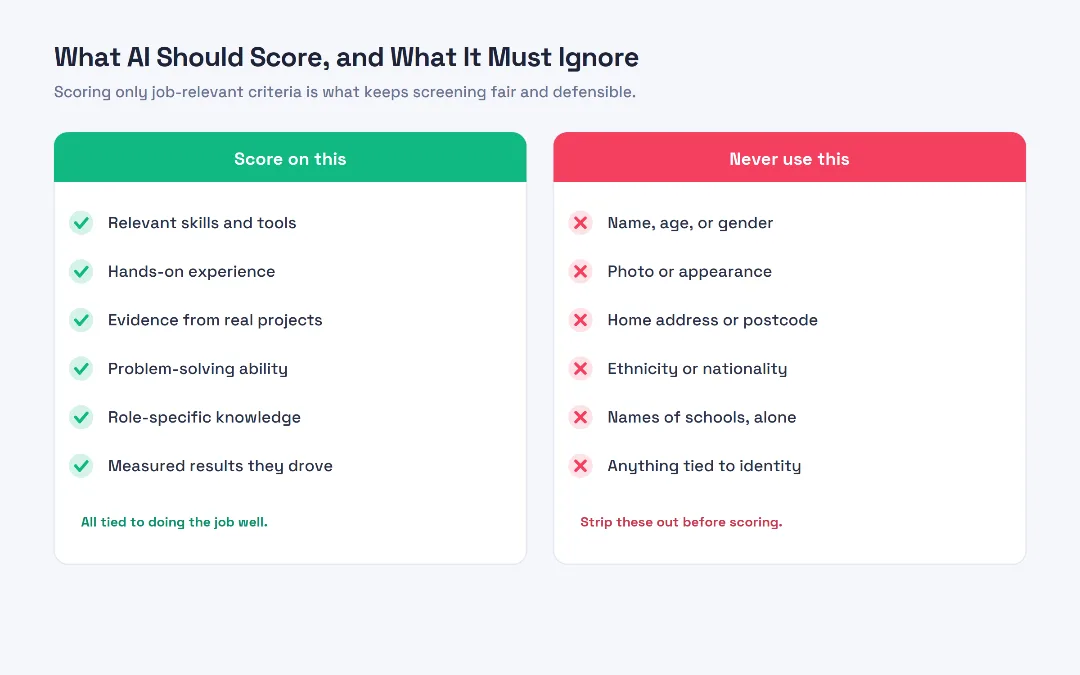
The single most important design decision in AI resume screening is what the AI is allowed to look at. As the split above shows, it should score only criteria tied to doing the job well: relevant skills and tools, hands-on experience, evidence from real projects, problem-solving, role-specific knowledge, and measured results. It must never use anything tied to a person's identity, such as name, age, gender, photo, home address, ethnicity, or the prestige of a school on its own. Those attributes have nothing to do with job performance, and letting a model see them is how bias creeps in.
The practical way to enforce this is to strip identifying details out of each application before the AI ever scores it. Screen the work, not the worker. Done this way, AI resume screening can actually reduce some of the inconsistency and unconscious bias that creep into rushed manual review, because every candidate is measured against the same explicit rubric. The goal is fairer screening, not just faster screening.
What the AI hands your hiring team
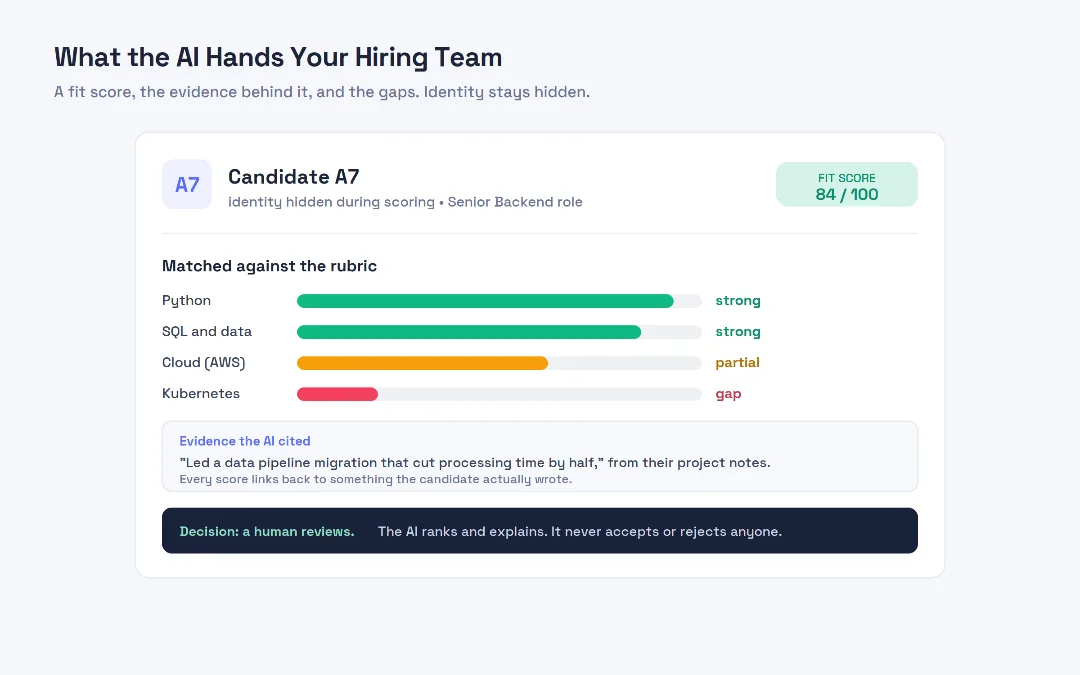
For each application, good AI resume screening produces a clear, explainable scorecard rather than a yes or no, as shown above. It gives a fit score against the job, shows which required skills the candidate matched and where the gaps are, and crucially, cites the evidence from the candidate's own words behind each judgement. That evidence matters enormously. A score you cannot explain is a score you cannot trust or defend, whereas a score that links back to "led a data pipeline migration that cut processing time by half" is something your hiring team can actually act on. Notice too that the candidate is shown by an anonymized identifier, because identity stayed hidden during scoring. The AI ranks and explains; it never accepts or rejects anyone.
A ranked shortlist, not a decision
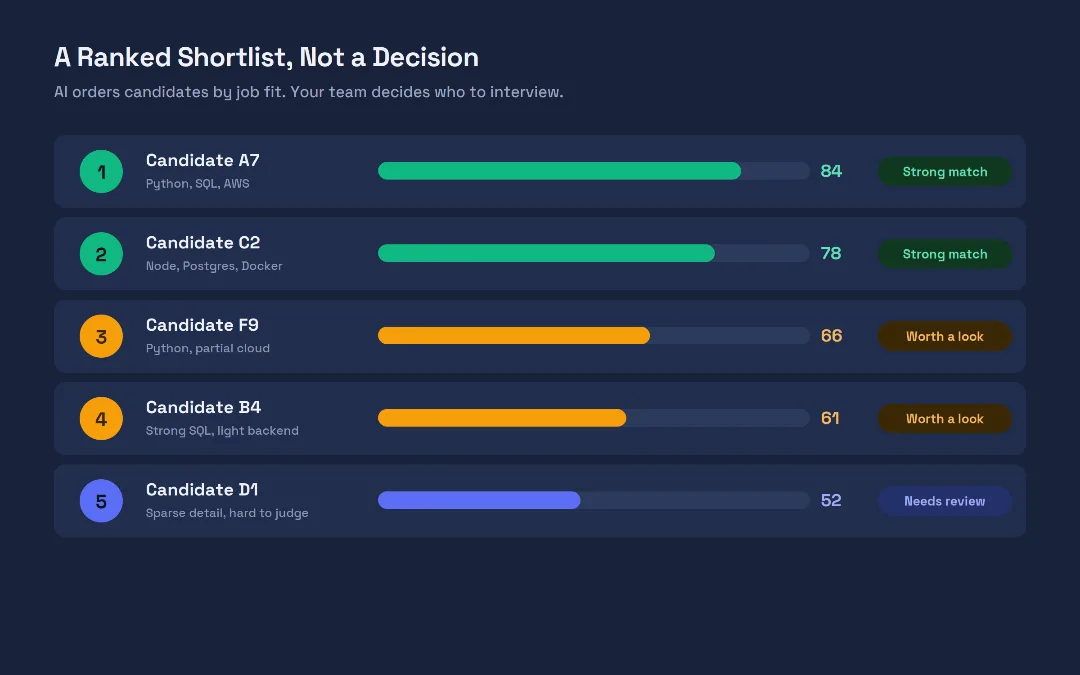
The output of the whole process is a ranked shortlist, like the one above, not a hiring decision. Candidates are ordered by job fit, with honest labels: strong matches near the top, promising-but-partial candidates in the middle, and a needs-review flag on anyone the AI could not assess confidently, often because their application was thin on detail. That last flag is important, because a low score from sparse information is not the same as a poor candidate, and those cases deserve a human look rather than a quiet rejection. AI resume screening exists to order the pile and surface the evidence, so your team spends its limited time on the people most likely to be a fit, then makes every real call themselves.
For your developers: building it responsibly
The examples use Python, but the logic fits any stack. The structure deliberately puts fairness first, with anonymization before scoring and a rubric the model must justify against.
Step 1: Define the rubric
Decide, up front, the job-relevant criteria you will score against. Writing this down is itself a fairness measure, because it commits you to consistent standards.
RUBRIC = {
"role": "Senior Backend Engineer",
"must_have": ["Python", "SQL / relational databases", "REST API design"],
"nice_to_have": ["AWS", "Kubernetes", "event-driven systems"],
"experience_years": 5,
"signals": ["evidence of shipping real projects", "measurable impact"],
}
Step 2: Anonymize before scoring
Strip identifying details so the model judges the work, not the person. This is the safeguard that does the most to reduce bias.
import re
def anonymize(text: str) -> str:
# Remove emails, phone numbers, and obvious identity lines
text = re.sub(r"\S+@\S+", "[email]", text)
text = re.sub(r"\+?\d[\d\s().-]{7,}\d", "[phone]", text)
text = re.sub(r"(?im)^(name|address|date of birth|gender|nationality):.*$",
"[redacted]", text)
return text
Step 3: Score against the rubric, with evidence
Ask the model to judge only the rubric and to cite the candidate's own words for every claim. Requiring evidence is what keeps the score explainable.
def score_application(clean_text, rubric):
prompt = f"""You assess a job application against a rubric. Score ONLY the
job-relevant criteria below. Do not infer or use age, gender, ethnicity, or any
personal identity. For every point, cite a short quote from the application as
evidence. Reply as JSON:
{{"fit": 0-100, "matched": [...], "gaps": [...], "evidence": [...],
"confidence": "high|medium|low"}}
Rubric: {rubric}
Application: {clean_text}"""
return json.loads(askLLM(prompt)) # your LLM call
Step 4: Rank and flag, never auto-reject
Sort by fit, but route low-confidence and borderline cases to a human instead of dropping them.
results = []
for app in applications:
r = score_application(anonymize(app.text), RUBRIC)
r["id"] = app.anon_id # e.g. "A7", not their name
results.append(r)
shortlist = sorted(results, key=lambda r: r["fit"], reverse=True)
for r in shortlist:
if r["confidence"] == "low":
r["flag"] = "needs human review" # thin application, do not reject
Step 5: Hand it to a human, and keep a record
The system presents the ranked, evidence-backed shortlist for review, and logs why each candidate ranked where they did.
for r in shortlist:
present_for_review(r) # a person decides who to interview
audit_log.write(r) # keep the reasoning for accountability
That is a complete AI resume screening pipeline that is fast, explainable, and fair by construction. It anonymizes first, scores only the job, demands evidence, never rejects on its own, and keeps a record. Those properties are not optional extras; they are what makes the tool responsible to use.
Guardrails that keep AI hiring fair
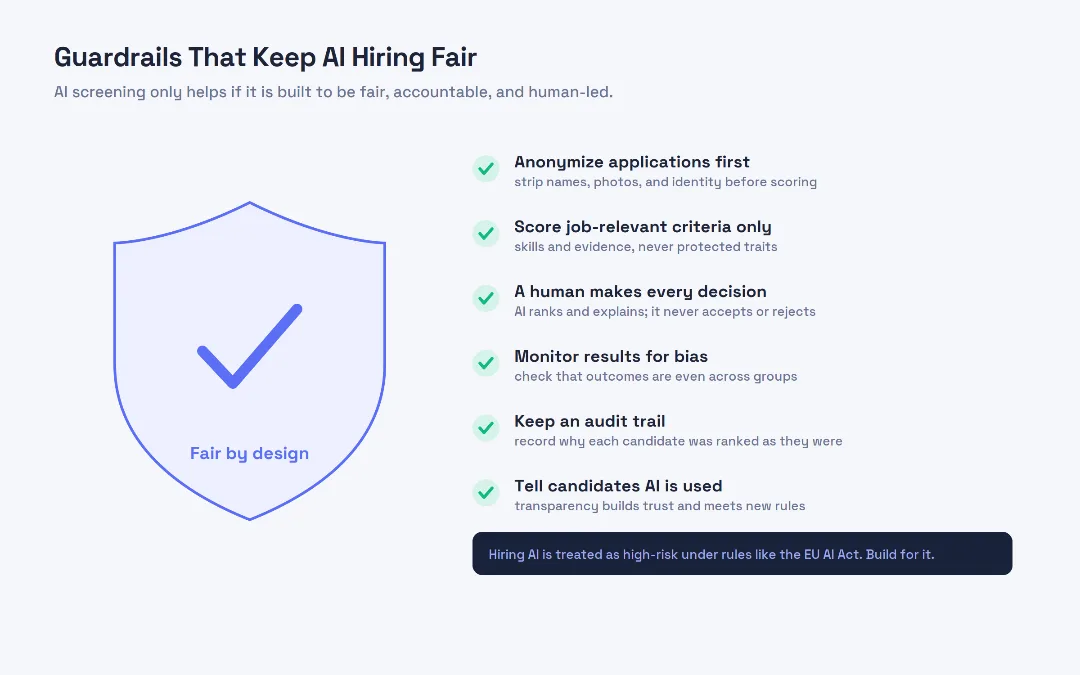
Beyond the code, a few standing practices keep AI resume screening on the right side of fairness and the law, summarized above. Anonymize applications before scoring. Score only job-relevant criteria. Keep a human making every decision, since the AI ranks but never hires or rejects. Monitor your outcomes to check the results are even across groups, because a model can pick up bias from historical data even when you do not show it protected attributes. Keep an audit trail of why each candidate was ranked as they were. And tell candidates that AI is part of your process. These are not just good manners; hiring tools are increasingly regulated, treated as high-risk under frameworks like the EU AI Act and subject to anti-discrimination law, so building this way protects your candidates and your business alike.
Faster screening, with judgement kept human
A pile of applications should not mean strong candidates get missed, and it no longer has to. Done responsibly, AI resume screening reads every application against the same job-relevant rubric, hides identity to reduce bias, cites its evidence, and hands your team a ranked shortlist to act on, while every real decision stays with a person. Start small, on one role, with anonymization and a clear rubric in place from day one, and review the shortlist closely while you build trust in it. The result is a hiring process that is both faster and fairer, where your team spends its time interviewing the strongest candidates instead of drowning in the inbox.
Articles Worth Reading
In a recent project, I built an AI document assistant that answers questions directly from a client's own files, complete with sources.
If you're just getting started, learn how to set up Claude Code and ship your first task.
If missed calls are costing you customers, an AI voice agent that answers every call can book appointments and route urgent conversations to a human.
Learn how route optimization can cut fuel costs and keep deliveries on time by planning smarter routes.
Learn how AI lead qualification can score and follow up on your sales leads the moment they arrive.
Learn how simple demand forecasting can help cut food waste and control costs by stocking closer to real demand.
Useful Links
Frequently Asked Questions
Let's build
Have a project worth building?
If this maps to a problem in your business, tell me about it. I will tell you honestly whether software or AI can fix it, and how I would build it.
Continue Reading
AI Development13 min read
Build an AI Agent to Automate a Real Task
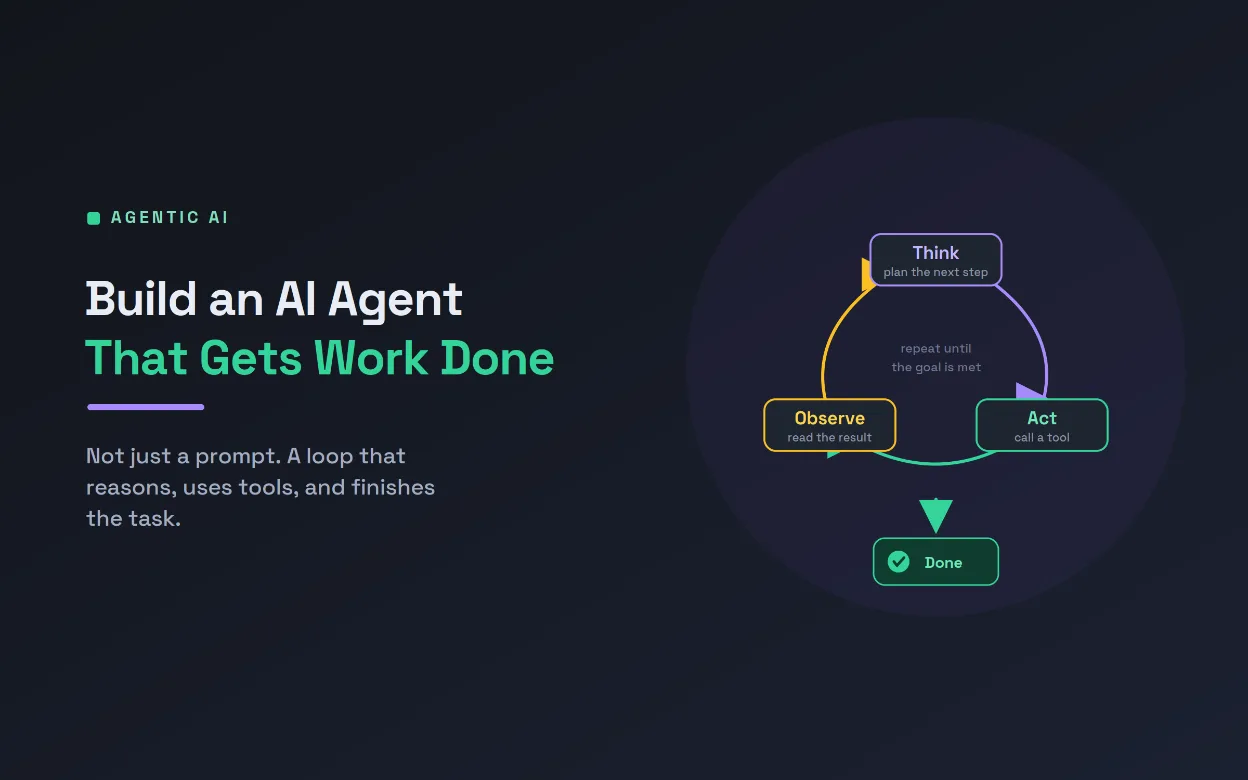
An AI agent is not a chatbot, it is an LLM in a loop that reasons, calls tools, and works until a task is done. This technical guide builds a real inbox-triage agent step by step, with tool schemas, the agent loop, permissions, and production guardrails.
Aug 05, 20264 views
AI Development9 min read
Predict Customer Churn and Win Them Back With AI
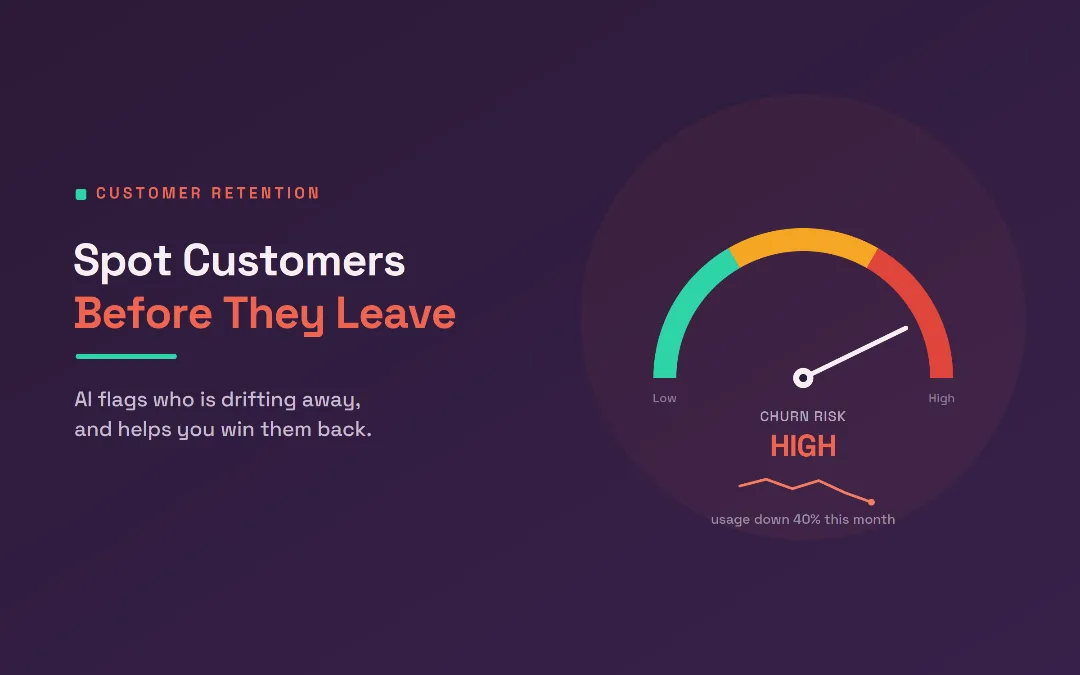
Most customers leave quietly, without a complaint. This guide shows how AI predicts customer churn from the small signals that come before someone cancels, then drafts a personal win-back message, so your team can act while there is still time.
Jul 13, 20262 views
AI Development12 min read
Automate Your Product Photography With AI Editing
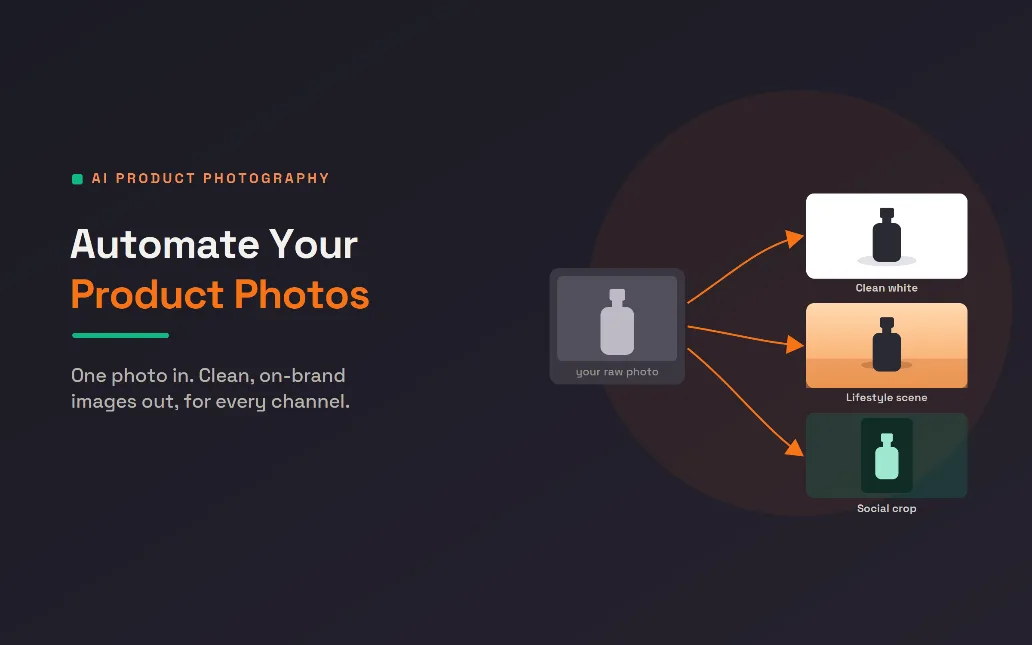
Good product photography sells, but shooting and editing it eats time and money. This guide shows how AI turns one raw photo into clean, on-brand product photos for every channel, and how to build the pipeline so your whole catalog updates itself.
Jul 08, 20268 views