Predict Customer Churn and Win Them Back With AI
9 min read
2 views
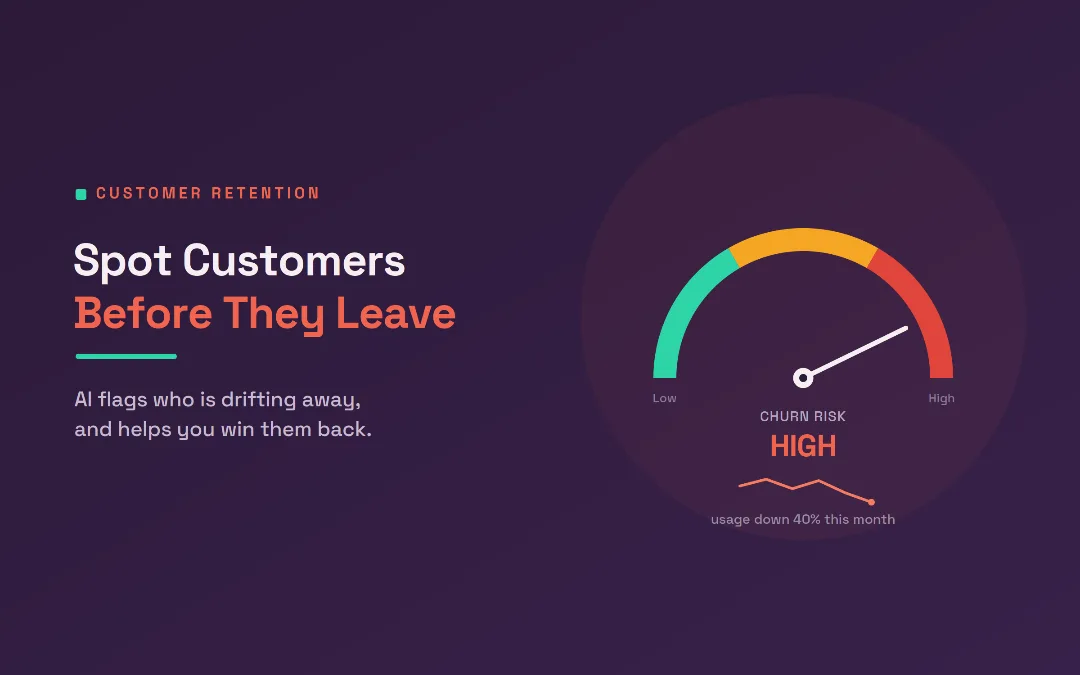
The customer who left without saying a word
Most customers do not send an angry email before they go. They simply fade. The logins get rarer, the usage drops, a renewal slips by, and one day you realise an account that used to be active is gone. By then it is usually too late to do anything about it. This is the quiet, costly nature: the warning signs are there for weeks, but no single one is loud enough to notice in a busy week. Predicting customer churn means catching those signs early, while you can still act, and that is something AI is unusually good at. It can watch every customer's behaviour at once, flag the ones who are slipping, and even draft the message that might bring them back.
This article explains the approach for business owners, and then, for your developers, how to build a working version. The goal is not a perfect crystal ball. It is a practical early warning system that turns a vague worry about customer churn into a clear, ranked list of who needs attention today, paired with a head start on what to say to them. Keeping a customer you already have is far cheaper than winning a new one, which is exactly why getting ahead of it pays off so quickly.
The quiet signals that come before a customer leaves
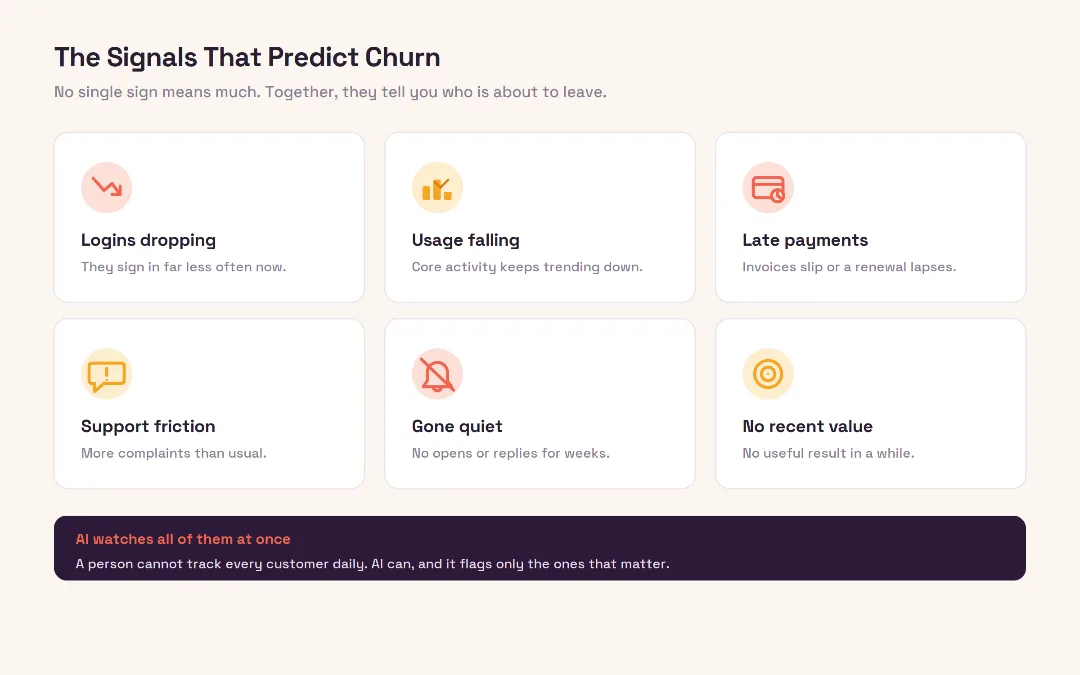
This is rarely caused by one event. It builds from a pattern, and the signals above are the ones that matter most. A drop in how often someone logs in, a steady decline in their core usage, a late or missed payment, a rise in support complaints, a long silence with no opens or replies, and a stretch where they simply have not gotten any value from your product. Individually, none of these is alarming. Together, they paint a clear picture of a customer drifting toward the door.
The challenge lies in the fact that no individual can monitor these signals across hundreds or thousands of customers daily. That’s where AI comes in, taking off your burden. It simultaneously analyzes all the signals for everyone and identifies the handful of accounts where the pattern has become concerning. Instead of reacting to customer churn after a cancellation, you receive a subtle heads up before it occurs.
Turning signals into a risk level, and a level into an action
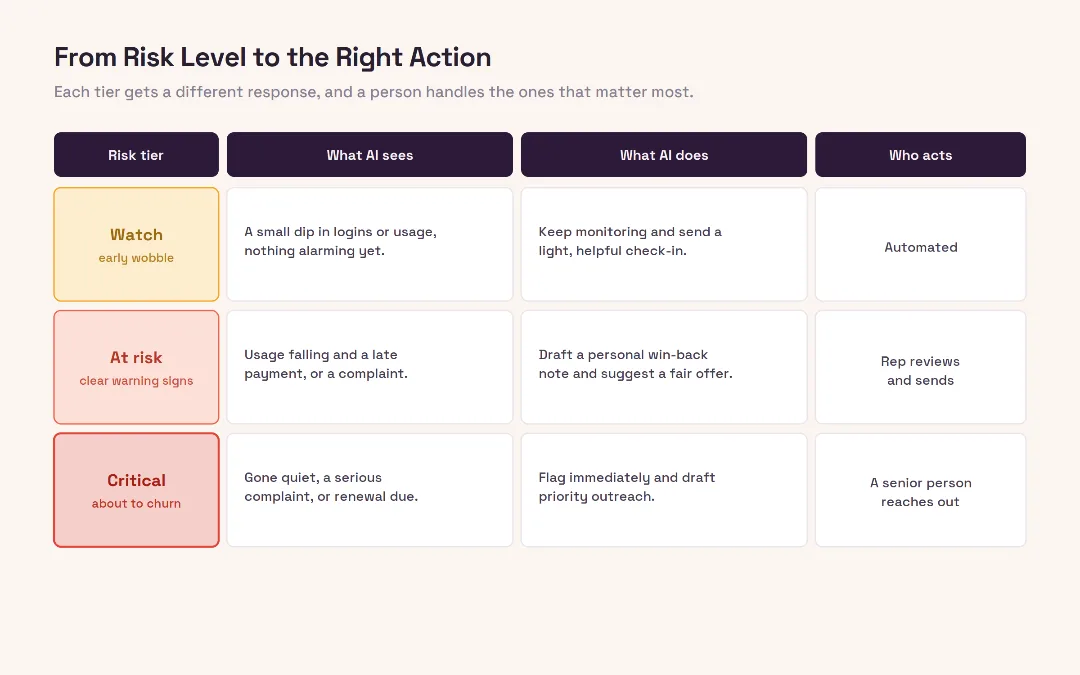
A risk score is only useful if it leads to the right response, so the practical step is to sort customers into a few tiers and give each tier a clear action, as the table above lays out. A customer in the watch tier, showing a small early wobble, just needs gentle monitoring and a light, helpful check-in that can be fully automated. A customer who is at risk, with usage falling and a late payment, deserves a personal win-back note and a fair offer, drafted by AI and sent by a human. A critical customer, who has gone quiet or raised a serious complaint with a renewal looming, gets flagged immediately for a senior person to reach out directly. Matching the effort to the risk is what keeps your team focused, so the highest stakes cases of customer churn always get a real human, not an automated nudge.
For your developers: building churn prediction step by step
The examples use Python because this is a data task, but the same logic fits any stack, and the scoring stays transparent so you can explain why a customer was flagged.
Step 1: Pull the signals for each customer
Start by gathering the behaviour that predicts churn, per customer.
SELECT
c.id,
c.name,
c.plan,
date_part('day', now() - max(e.created_at)) AS days_since_active,
count(e.*) FILTER (WHERE e.created_at > now() - interval '30 days') AS usage_30d,
count(e.*) FILTER (WHERE e.created_at BETWEEN now() - interval '60 days'
AND now() - interval '30 days') AS usage_prev_30d,
count(t.*) FILTER (WHERE t.created_at > now() - interval '30 days') AS recent_tickets,
bool_or(i.status = 'overdue') AS has_overdue_invoice
FROM customers c
LEFT JOIN events e ON e.customer_id = c.id
LEFT JOIN tickets t ON t.customer_id = c.id
LEFT JOIN invoices i ON i.customer_id = c.id
GROUP BY c.id;
Step 2: Load the data
import pandas as pd
df = pd.read_sql(query, connection)
print(len(df), "customers to assess")
Step 3: Score churn risk transparently
A simple weighted score keeps the result explainable, which matters when a person has to act on it. You can upgrade to a trained model later, but start where you can see the reasons.
def churn_risk(row):
score, reasons = 0, []
if row.days_since_active > 21:
score += 35; reasons.append("inactive for 3+ weeks")
if row.usage_prev_30d and row.usage_30d < row.usage_prev_30d * 0.5:
score += 30; reasons.append("usage down over 50%")
if row.has_overdue_invoice:
score += 20; reasons.append("overdue invoice")
if row.recent_tickets >= 3:
score += 15; reasons.append("multiple recent complaints")
tier = "critical" if score >= 70 else "at_risk" if score >= 40 else "watch"
return pd.Series({"risk": score, "tier": tier, "reasons": reasons})
df = df.join(df.apply(churn_risk, axis=1))
When you want more accuracy, a model like scikit-learn's logistic regression can learn the weights from your own history of who churned. The transparent version above is the right place to begin, because every flag comes with a plain-language reason.
Step 4: Draft a win-back message for at-risk customers
For each flagged customer, let AI write a personal note grounded in why they are at risk, without sounding like a robot or a guilt trip.
def winback_message(row):
prompt = f"""Write a short, warm win-back email to a customer who may be
leaving. Be personal and specific, remind them of the value they got, and offer
a fair incentive. Keep it under 110 words and low pressure.
Customer: {row['name']} (plan: {row['plan']})
Why they are at risk: {", ".join(row['reasons'])}"""
return askLLM(prompt) # your LLM call
Step 5: Flag the people who need a person
Bring it together so the riskiest customers reach a human with a draft already prepared.
at_risk = df[df.tier.isin(["at_risk", "critical"])].sort_values("risk", ascending=False)
for _, row in at_risk.iterrows():
draft = winback_message(row)
queue_for_review(row, draft) # rep or owner reviews, then sends
That is a complete, explainable churn early warning system in a handful of functions. It never cancels, discounts, or emails on its own. It prepares the work and puts the important decisions in front of a person.
Writing a win-back note that actually works
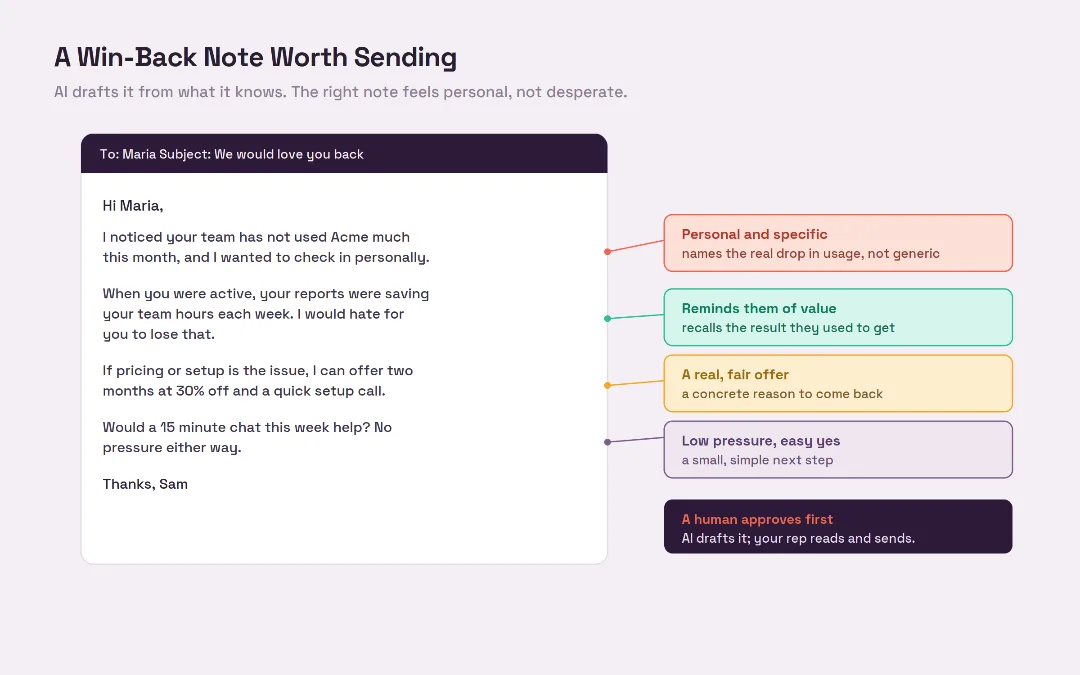
The message is where many win-back attempts fail, because a generic "we miss you" email convinces no one. A good win-back note, like the draft above, does four things. It is personal and specific, naming the real drop in usage rather than a vague greeting. It reminds the customer of the value they used to get. It makes a concrete, fair offer that gives them a genuine reason to return. And it stays low pressure, asking for a small, easy next step. AI is good at producing this from the signals it already has, but a human should always review and send it, especially for your most valuable accounts. The aim is to sound like a thoughtful person who noticed, not an algorithm that detected a lapsed account.
The payoff of acting early
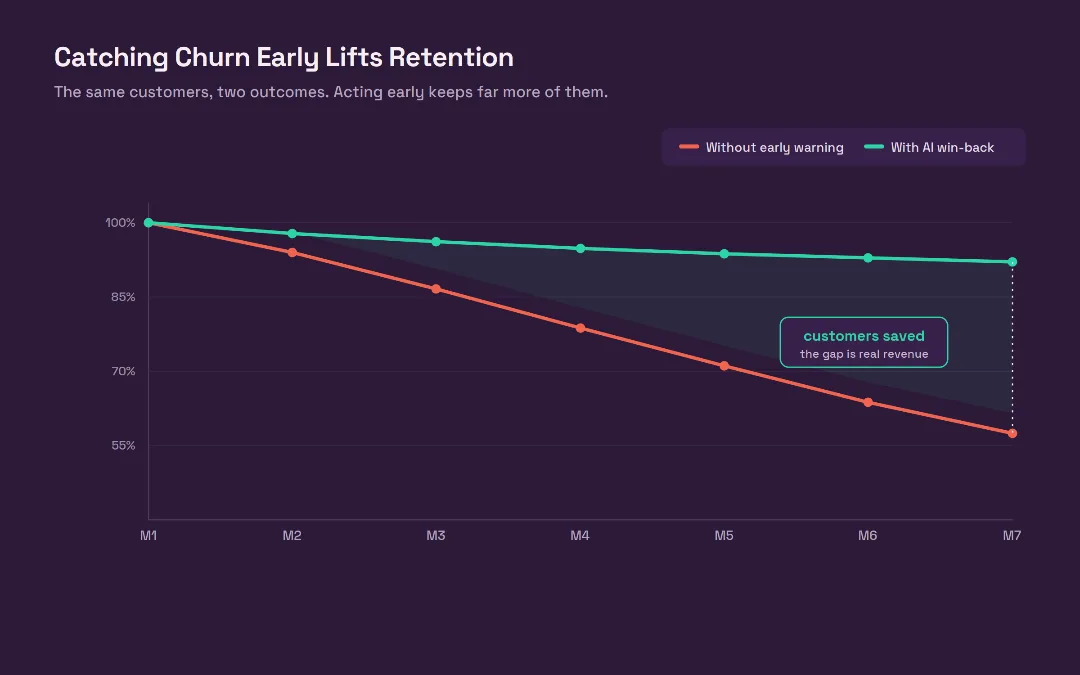
The reason any of this is worth doing comes down to the gap in the chart above. The same group of customers, handled two ways, ends up in very different places. Without an early warning system, churn compounds quietly and retention slides month after month. With AI flagging at-risk customers and helping you reach them in time, far more of them stay, and that gap is real, recurring revenue. Reducing it even slightly has an outsized effect, because every customer you keep continues to pay and costs nothing to re-acquire. Early action is what turns the prediction into money saved.
Keep the customers you already earned
Winning a customer is hard and expensive. Losing one quietly, when a timely note might have kept them, is a waste you can avoid. By using AI to predict customer churn from the small signals that come before a cancellation, sorting customers by risk, and drafting a personal win-back message for a human to send, you give your team the one thing they usually lack: time to act. Start simple, with a transparent score and your most at-risk customers, send a few thoughtful win-back notes, and measure how many you save. Then let it run quietly in the background, watching for the next customer who is about to slip away, so you can reach them while it still matters.
Articles Worth Reading
Learn how simple demand forecasting can cut food waste and costs by stocking closer to real demand.
If missed calls are costing you customers, consider an AI voice agent that answers every call so no lead slips through.
Learn how route optimization can trim fuel costs and keep deliveries on time by planning smarter, shorter paths.
If you're building automations that need to survive real-world use, learning how to design AI workflows with n8n and OpenAI can save you from pipelines that break in production.
I learned this the hard way while shipping production-ready AI agents for a client whose support bot double-refunded customers in its first week.
Useful Links
Frequently Asked Questions
Let's build
Have a project worth building?
If this maps to a problem in your business, tell me about it. I will tell you honestly whether software or AI can fix it, and how I would build it.
Continue Reading
AI Development13 min read
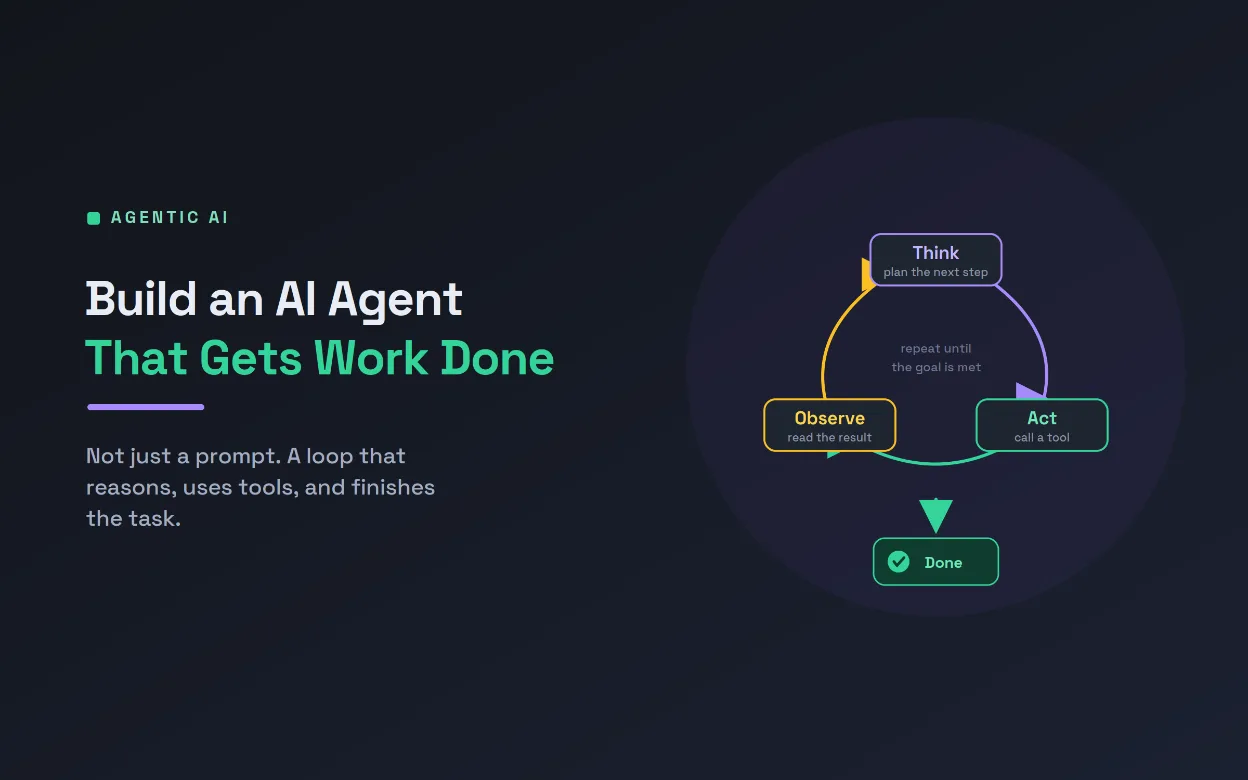
Build an AI Agent to Automate a Real Task
An AI agent is not a chatbot, it is an LLM in a loop that reasons, calls tools, and works until a task is done. This technical guide builds a real inbox-triage agent step by step, with tool schemas, the agent loop, permissions, and production guardrails.
Aug 05, 20264 views
AI Development10 min read
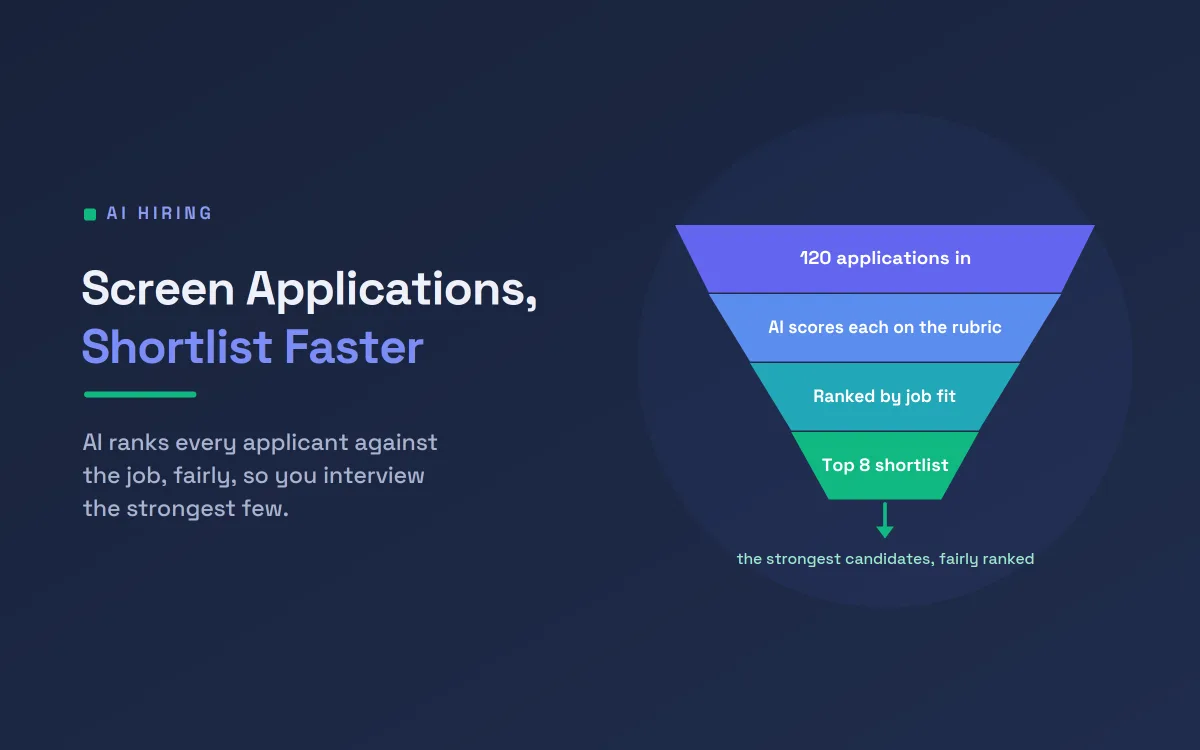
Screen Job Applications Faster With AI Shortlisting
A single open role can draw hundreds of applications. This guide shows how AI resume screening ranks candidates on job-relevant criteria, with the fairness safeguards and human oversight that responsible hiring demands, so your team spends its time on the strongest few.
Jul 18, 20266 views
AI Development12 min read
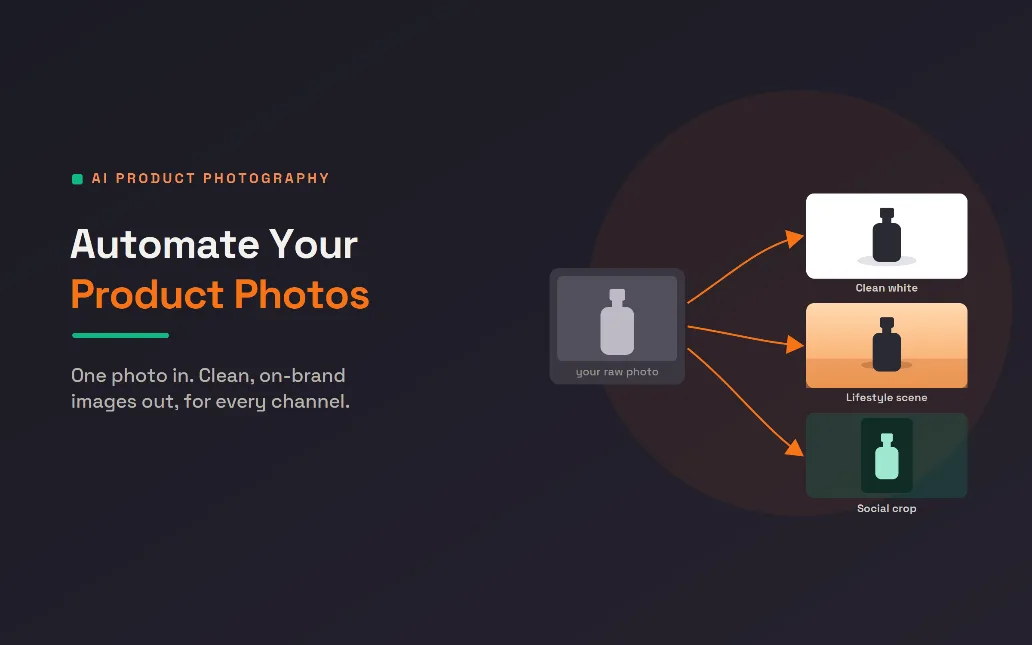
Automate Your Product Photography With AI Editing
Good product photography sells, but shooting and editing it eats time and money. This guide shows how AI turns one raw photo into clean, on-brand product photos for every channel, and how to build the pipeline so your whole catalog updates itself.
Jul 08, 20268 views