Cut Delivery Costs With Route Optimization
8 min read
7 views
The money your business leaves on the road
If your business delivers anything, from a bakery dropping off morning orders to a courier running fifty stops a day, there is a good chance you are spending more than you need to on the road. Drivers tend to follow habit and visit stops in the order the orders came in, not in the order that covers the least distance. Every extra mile is fuel you did not need to burn, time you cannot get back, and a later arrival for the customer at the end of the run. Route optimization is the practical fix, and it simply means working out the shortest sensible order to visit all your stops. This article explains how it works, what it is worth, and, for your developers, how to build a simple version.
The savings are not small. It is common for a smart route to cut total distance by twenty to thirty percent compared with driving stops in the order they were entered. On a busy delivery day, that is real money and a noticeably earlier finish.
Why Delivery Businesses Need Route Optimization
If your business delivers anything, from a bakery dropping off morning orders to a courier running fifty stops a day, route optimization is one of the most direct ways to lower your operating costs. The reason is simple. Drivers tend to visit stops in the order the orders arrived, not in the order that covers the least distance, and without route optimization every extra mile becomes fuel you did not need to burn, time you cannot recover, and a later arrival for the customer at the end of the run. Delivery route optimization solves this by calculating the shortest sensible order in which to visit every stop.
The savings are not trivial. Effective route optimization commonly reduces total distance by twenty to thirty percent compared with driving stops in the order they were entered. On a busy delivery day, that reduction in mileage is real money saved and a noticeably earlier finish for your drivers.
Why Driving on Habit Costs More Than Route Optimization
The problem is easy to picture once you see it. Imagine a depot and a handful of stops scattered across town. A driver working from a printed list visits them from top to bottom, crossing back and forth, sometimes passing within a street of a later stop without delivering, only to double back later. This is precisely the waste that route optimization removes.
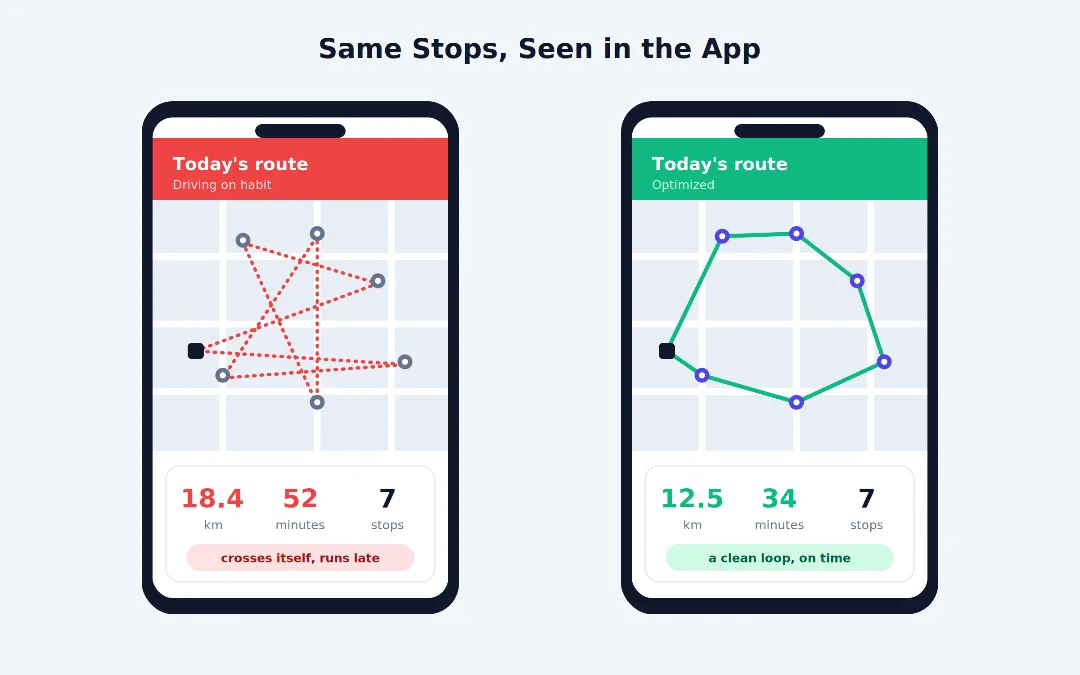
The two maps above show the same stops twice. On the left, the route follows the order the orders arrived and crosses itself repeatedly, covering 18.4 km. On the right, route optimization has resequenced the same stops into a clean loop of just 12.5 km. Nothing changed except the order, yet the optimized route is roughly a third shorter. Multiply that across every vehicle and every working day, and route optimization becomes a substantial saving on fuel, driver hours, and wear on your vans.
There is a customer side too. A shorter, better ordered route means more reliable arrival times, which is exactly what people care about when they are waiting for a delivery. Smarter routing improves your margin and your reputation at the same time.
How route optimization actually works
At its core, route optimization is a classic problem that computers handle exceptionally well. You give the route optimizer a list of stops, it measures the distance between every pair of them, and then it searches for the visiting order that keeps the total distance as low as possible while still reaching each stop. Beyond the basics, modern route optimization can also respect real constraints, such as delivery time windows, how much each van can carry, and when each driver begins and ends a shift.
You do not need an elaborate system to benefit. Even a straightforward approach to route optimization comfortably outperforms driving on habit, and you can introduce more sophisticated rules as your delivery operation grows.
For your developers: building a simple optimizer step by step
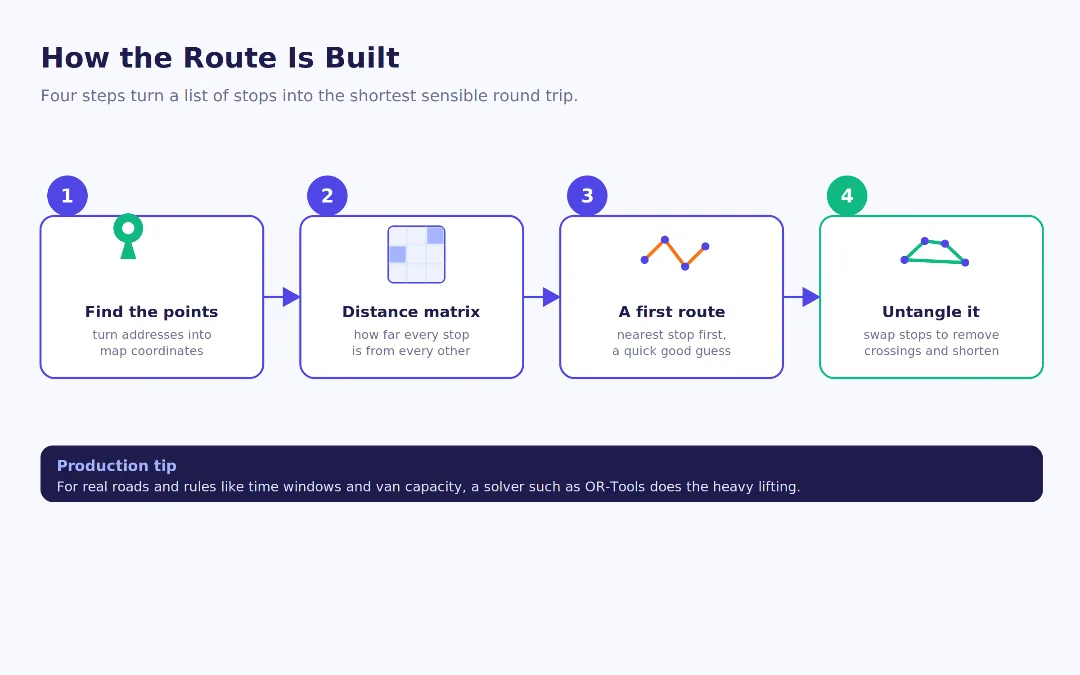
Here is a clear path your team can follow. The examples use Python because it reads cleanly, but the same logic works in any language, and it can sit behind a small API that your existing app calls.
Step 1: Measure the distance between stops
First we need a way to measure how far apart two points are. For a quick version, the straight line distance between their coordinates is enough to start.
from math import radians, sin, cos, asin, sqrt
def distance_km(a, b):
lat1, lon1, lat2, lon2 = map(radians, [a[0], a[1], b[0], b[1]])
dlat, dlon = lat2 - lat1, lon2 - lon1
h = sin(dlat / 2) ** 2 + cos(lat1) * cos(lat2) * sin(dlon / 2) ** 2
return 2 * 6371 * asin(sqrt(h)) # 6371 km is the Earth's radius
We also need to measure the length of a whole route, so we can compare one order of stops against another.
def route_distance(route, stops):
total = 0
for i in range(len(route) - 1):
total += distance_km(stops[route[i]], stops[route[i + 1]])
return total
Step 2: See how bad the habit route is
Before optimising, measure the route that follows the order the stops were entered. This is the baseline you are trying to beat.
# The habit: drive the stops in the order they came in
naive_route = list(range(len(stops))) # 0, 1, 2, ... just as entered
print(round(route_distance(naive_route, stops), 1), "km") # usually far from optimal
Step 3: Build a good first route
A simple and effective starting point is to always drive to the nearest stop you have not visited yet. This is called the nearest neighbour method, and it produces a decent route in a fraction of a second.
def nearest_neighbor(stops, start=0):
unvisited = set(range(len(stops)))
route = [start]
unvisited.remove(start)
while unvisited:
last = route[-1]
nxt = min(unvisited, key=lambda i: distance_km(stops[last], stops[i]))
route.append(nxt)
unvisited.remove(nxt)
return route
Step 4: Untangle the route to shorten it
The first route is good but rarely perfect, and it often crosses itself. A method called 2-opt repeatedly reverses sections of the route whenever doing so makes it shorter, which removes those crossings.
def two_opt(route, stops):
improved = True
while improved:
improved = False
for i in range(1, len(route) - 1):
for j in range(i + 1, len(route)):
# Try reversing the section between positions i and j
candidate = route[:i] + route[i:j + 1][::-1] + route[j + 1:]
if route_distance(candidate, stops) < route_distance(route, stops):
route = candidate
improved = True
return route
Step 5: Put it together and compare
Now run the two steps in order and measure the result against the habit route.
route = nearest_neighbor(stops)
route = two_opt(route, stops)
print(round(route_distance(route, stops), 1), "km") # much shorter than the naive order
For most small delivery runs, this simple pipeline already cuts a meaningful slice off the distance. The output is just an order of stops, which you can hand to your drivers as a clear, sequenced list.
When to reach for a real solver
The version above uses straight line distance and ignores extra rules. For production, two upgrades matter. First, swap the straight line distance for real road distances and times from a routing service, so the route respects actual streets and traffic. Second, when you have rules like delivery time windows, vehicle capacity, or multiple vans, use a proven solver such as Google OR-Tools, which handles these constraints far better than hand written code. The thinking is the same. You are still finding the cheapest order to visit every stop, just with more of the real world built in.
Making it work in the real world
A few practical habits decide whether this actually saves money. Keep your stop addresses clean, because a bad address sends a driver to the wrong place and ruins the route. Let dispatchers override the suggestion when they know something the system does not, like a road closure or a fragile customer relationship. And start with one route or one vehicle, prove the saving, then roll it out. The goal is to support your drivers with a smarter plan, not to remove their judgement.
What Route Optimization Means for Your Business
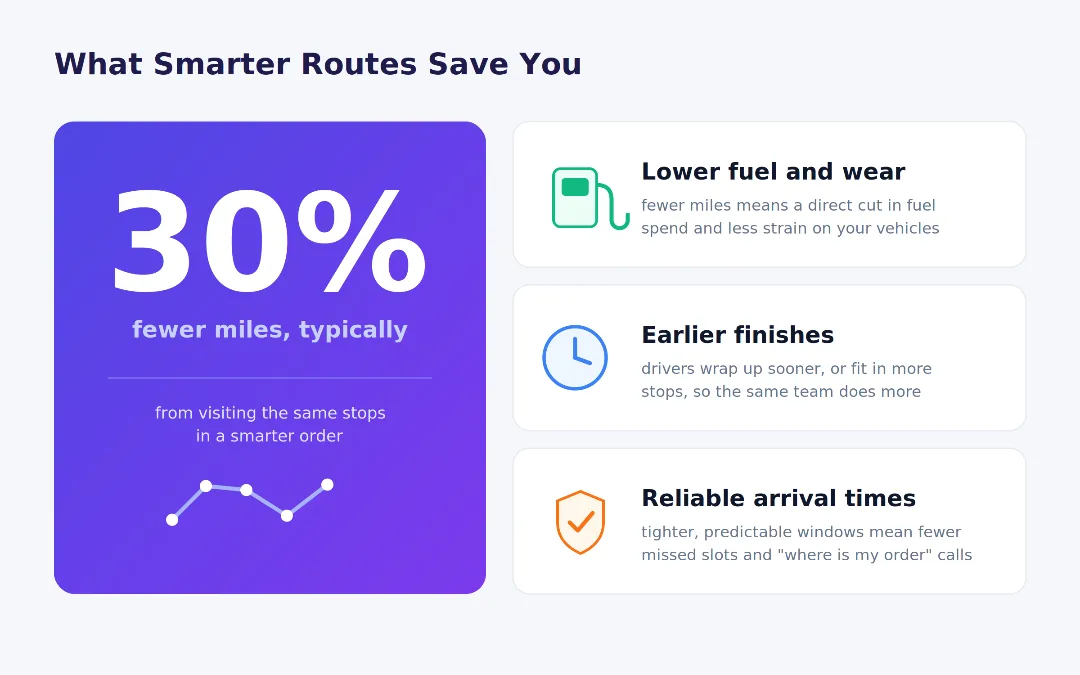
The payoff from route optimization arrives in several places at once. Fewer miles translate into a direct cut in fuel and vehicle wear. Shorter, optimized routes let drivers finish earlier or fit in additional stops, so the same team delivers more. And the tighter, more predictable arrival times that route optimization produces mean more satisfied customers and fewer "where is my delivery" calls. For any business that runs vehicles, route optimization is one of the clearest examples of technology turning a daily routine into measurable savings.
Articles Worth Reading
Looking to improve operational efficiency and reduce unnecessary costs? How Simple Demand Forecasting Cuts Food Waste and Costs explains how data-driven forecasting helps businesses make smarter inventory decisions.
Never miss a potential customer enquiry again. An AI voice agent that answers your calls so you never miss a customer explores how AI-powered voice assistants can provide round-the-clock customer engagement and lead qualification.
If your application performs well locally but struggles after deployment, Fast in Dev, Slow API in Production: Fixing Your API breaks down the common causes and practical solutions for production performance issues.
Memory leaks can silently degrade application performance over time. How I Eliminated Memory Leaks in a High-Traffic Node.js API That Everyone Thought Was “Stateless” shares a real-world debugging process and the techniques used to restore stability.
Caching is not always a performance win. Our Cache Made the App Slower. The Redis Cache Mistake I’ll Never Repeat highlights common caching mistakes and the lessons learned from a costly optimization attempt.
External Links
Frequently Asked Questions
Let's build
Have a project worth building?
If this maps to a problem in your business, tell me about it. I will tell you honestly whether software or AI can fix it, and how I would build it.
Continue Reading
Backend Engineering10 min read
Prevent Duplicate Payments: A Developer's Guide
Duplicate charges are one of the most damaging bugs in any checkout, and the code usually looks correct. This guide explains why duplicate payments happen and shows you, step by step with code, how to prevent duplicate payments on any stack.
Jun 15, 202613 views

Backend Engineering17 min read
How a Hidden N+1 Query Slowed API by 6x and the Exact Steps I Used to Fix It
The API wasn’t crashing. Nothing looked broken. But production response times quietly became six times slower. This is a real-world breakdown of how a hidden N+1 query slipped through reviews, how I proved it in Laravel, and the exact steps that fixed it permanently.
Mar 12, 2026139 views

Backend Engineering9 min read
How I Built an AI-Assisted Log Analysis System to Catch Production Issues Before Users Did
Logs were there. Alerts were there. Incidents still slipped through. This guide explains how I combined traditional logging with AI-driven pattern analysis to proactively detect production issues and reduce firefighting.
Mar 12, 202611 views