We Thought Microservices Would Scale Us Faster. Instead, It Slowed the Team and Burned Money
7 min read
33 views

Microservices are sold as the natural evolution of a growing product. Better scalability. Independent deployments. Faster teams. On paper, it sounds like maturity.
In reality, adopting microservices too early nearly stalled our business.
At the time, the logic felt solid. The product was growing, more features were coming in, and we didn’t want a “bloated monolith.” So we split services, added queues, introduced separate deployments, and congratulated ourselves for being future-ready.
The problems didn’t show up immediately. They crept in quietly.
The Real Challenge We Underestimated
The challenge wasn’t scaling traffic. It was scaling coordination.
Suddenly, a single feature required changes across multiple services. Local development became painful. Debugging turned into log-hopping across systems. A small production issue meant checking multiple dashboards, queues, and APIs.
Our team size hadn’t changed, but the operational surface area had tripled.
What used to be a simple deployment became a coordinated release. One service lagging behind could block others. The overhead was invisible to the business initially, but delivery timelines started slipping.
Why Microservices Failed Us at This Stage
Microservices assume a few things many teams don’t have yet:
Strong DevOps maturity
Clear domain boundaries
Independent teams owning services end-to-end
We had none of those fully in place.
The services weren’t truly independent. They shared the same database logic patterns. Business rules were duplicated because extracting shared logic felt “anti-microservice.” That duplication caused subtle inconsistencies, especially in billing and permissions.
Costs went up too. More services meant more infrastructure, more monitoring, more CI pipelines. Revenue didn’t increase at the same pace. That imbalance hurts startups quietly until it suddenly hurts badly.
What I Changed Instead
The fix was uncomfortable because it went against popular advice.
We consolidated.
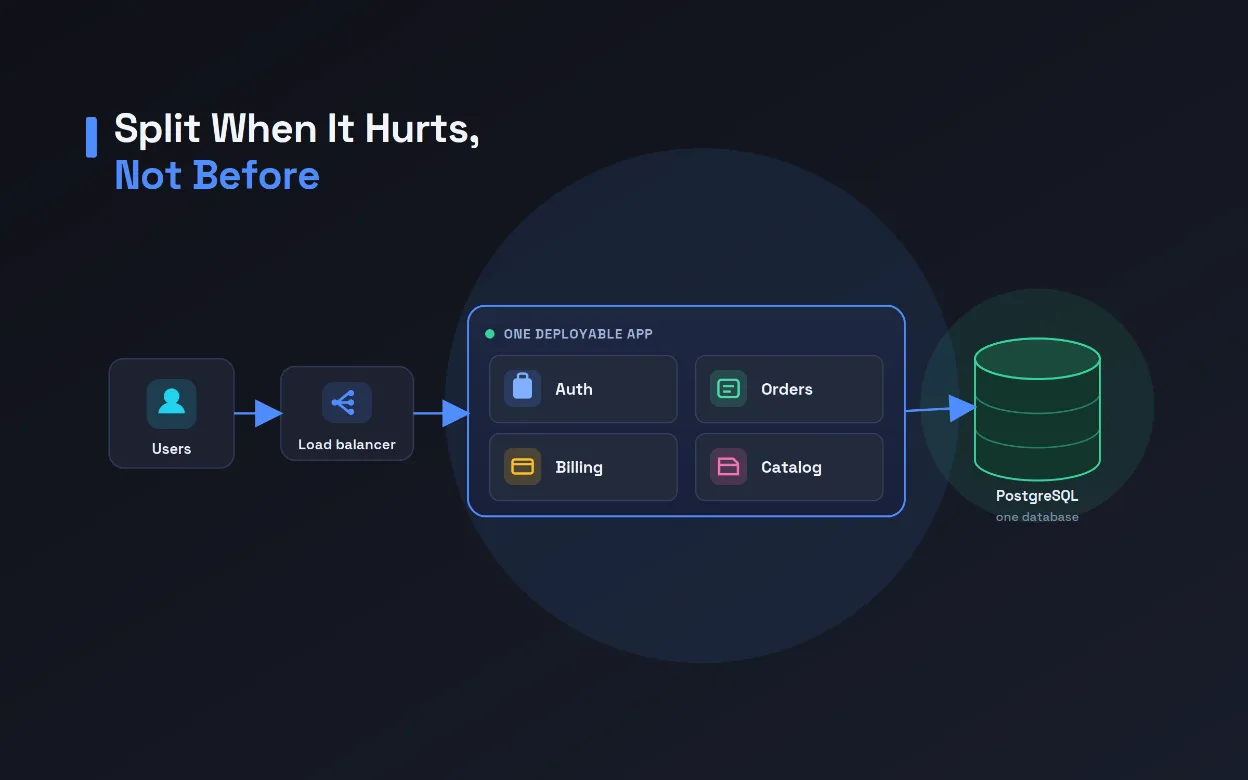
Not back into a messy monolith, but into a modular monolith. Clear internal boundaries. Shared deployment. Single source of truth for core business logic.
We kept asynchronous processing where it actually made sense, like heavy background jobs and integrations. But core workflows lived together again, which drastically reduced coordination overhead.
We also rewired ownership. Instead of “this service belongs to everyone,” we aligned modules to business capabilities. When something broke, responsibility was obvious. That alone reduced resolution time.
How This Improved Delivery and Business Outcomes
Feature delivery sped up almost immediately. Developers spent time solving problems instead of chasing logs. Onboarding new engineers became easier because the system was understandable again.
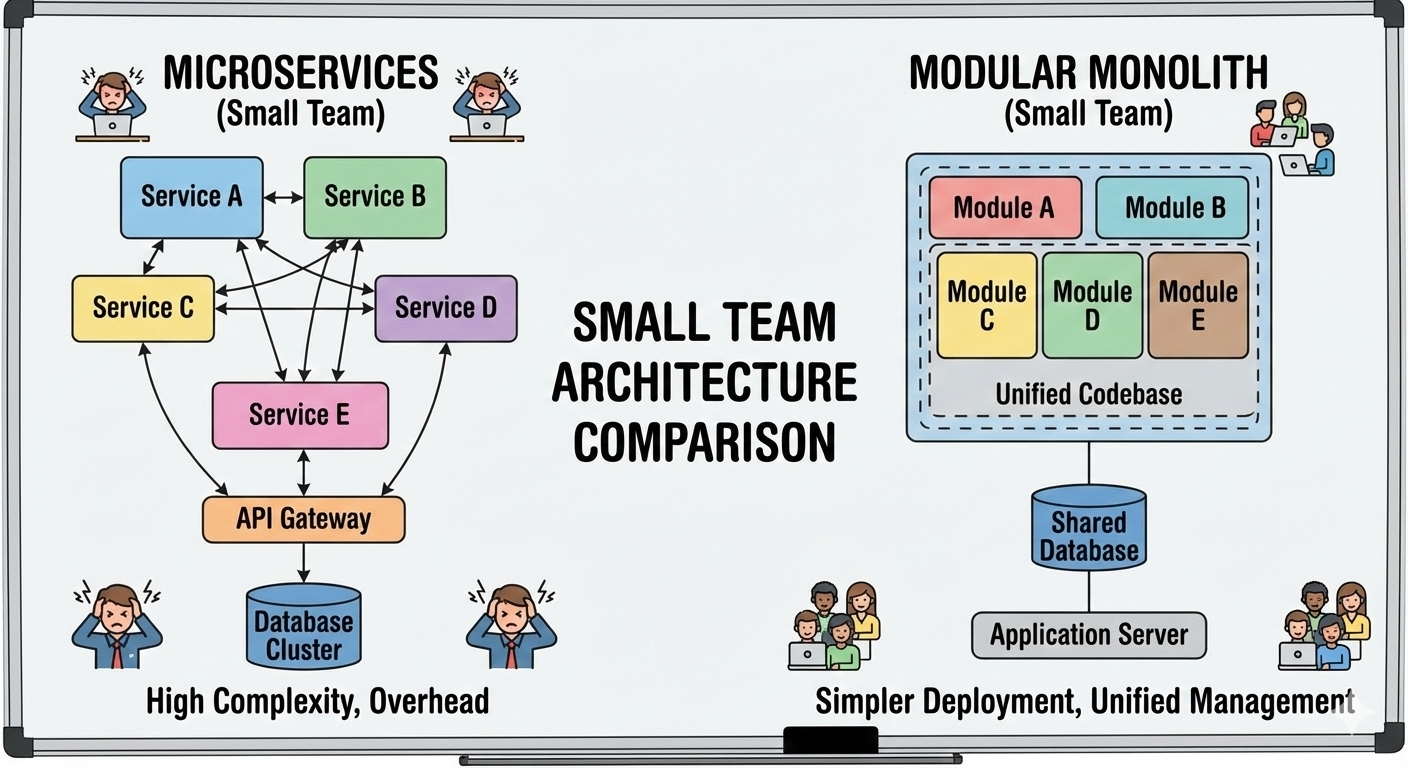
From a business standpoint, infrastructure costs dropped. Incidents reduced. More importantly, roadmap commitments became reliable again. Clients trust teams that ship predictably, not teams with fancy architecture diagrams.
Microservices didn’t fail us because they’re bad. They failed us because we weren’t ready.
Wrong Approach (Premature Service Split)
// Order Service
POST /orders
// Pricing Service
POST /calculate-price
// User Service
GET /user-roleEach request depended on multiple network calls for a single action. Latency, failures, and debugging complexity piled up fast.
Production-Grade Solution (Modular Monolith)
// OrderModule
class OrderService {
createOrder(user, amount) {
const price = Pricing.calculate(user, amount)
return OrderRepository.create(user.id, price)
}
}Modules are separated logically, not physically. The boundaries are enforced in code, not by network calls. You earn simplicity first, then distribute later when scale demands it.
Suggested Links:
Know more about How a Hidden N+1 Query Slowed API by 6x and the Exact Steps I Used to Fix It and A Single Missing Database Index Took Our App from 120ms to 4.8s. Here’s How I Found It
Frequently Asked Questions
Let's build
Have a project worth building?
If this maps to a problem in your business, tell me about it. I will tell you honestly whether software or AI can fix it, and how I would build it.