How Service-Based IT Companies Stop Undervaluing Their Work
it services business
pricing system design
tech services company
ai assisted pricing
it company profitability
it services pricing
13 min read
8 views

When a service-based IT companies struggle, the instinct is to chase more clients or work longer hours. Pricing rarely feels like the problem, because invoices are going out and money is coming in.
But pricing silently defines everything else. It determines the kind of clients you attract, how they behave, how much pressure your team feels, and whether growth creates freedom or stress.
In the early phase, most pricing decisions are fear-driven. Founders price to win deals, not to build a business. That works temporarily. Long term, it becomes the main reason companies stay busy but underpaid.
The Hidden Cost of “Competitive” Pricing
Competitive pricing usually means one thing in services: charging less than you should.
Low pricing doesn’t just reduce margins. It increases scope creep, because clients feel entitled to “small extras.” It delays payments, because urgency drops when cost feels low. It also makes hiring risky, because margins can’t absorb mistakes.
This is why two companies with the same technical skills can end up in very different places financially. Pricing shapes behavior long before delivery does.
Why Hourly and Daily Rates Stop Working
Hourly pricing feels fair, especially for engineers. Time feels measurable and objective. In reality, it punishes experience.
As teams get better, they solve problems faster. With hourly billing, efficiency reduces revenue. That creates a perverse incentive to work slower or over-explain effort.
At scale, hourly pricing also makes revenue unpredictable. Forecasting becomes guesswork. Profitability depends on utilization instead of outcomes.
This is where many service companies stall.
Shifting the Mental Model – From Effort to Outcome
The pricing shift that unlocks profitability is moving from “how long it takes” to “what problem gets solved.”
Clients don’t pay for code, frameworks, or hours. They pay to reduce risk, save time, or increase revenue. Pricing should reflect that.
This doesn’t mean arbitrary pricing. It means anchoring price to impact, complexity, and responsibility, not raw effort.
Designing a Pricing System (Not Just a Price)
Strong service companies don’t negotiate prices endlessly. They design pricing systems.
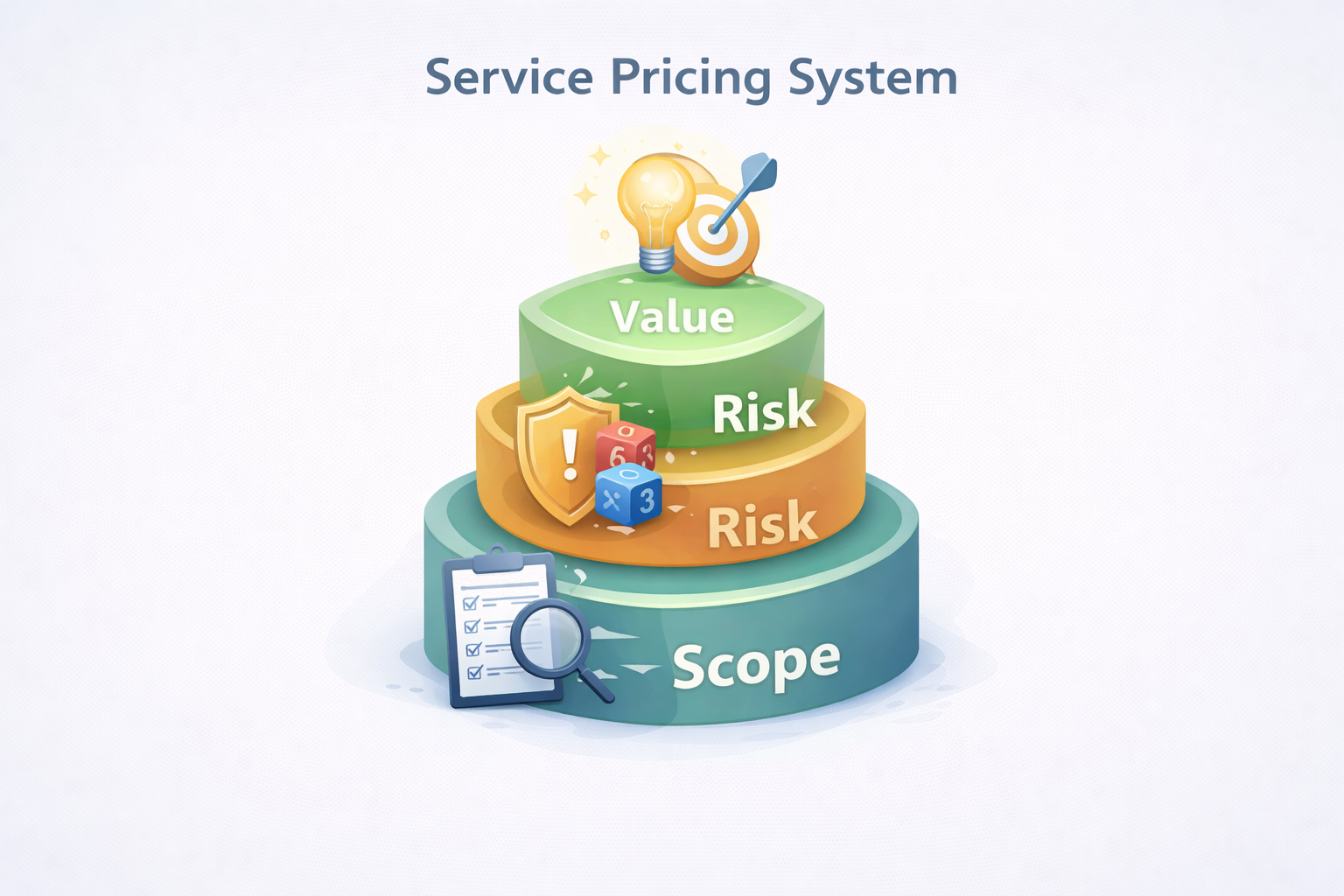
A pricing system defines:
What is included and what is not
How scope is frozen
How changes are handled
How risk is priced
Once this is explicit, conversations become easier and margins stabilize. This is also where AI quietly becomes useful.
How AI Helps Price Services More Rationally
AI does not decide prices. It provides context founders usually lack.
By analyzing past projects, AI can surface patterns humans miss:
Which project types consistently overrun
Where scope creep usually starts
Which clients require the most coordination
What complexity signals predict delays
To make this practical, historical project data can be normalized and compared before pricing new work.
function normalizeScope(text) {
return text
.toLowerCase()
.replace(/\d+/g, "<num>")
.replace(/urgent|asap|tight deadline/g, "<risk>");
}This allows new proposals to be compared against known risk patterns instead of relying on gut feeling.
Packaging Services to Reduce Negotiation
One major shift that improves pricing discipline is packaging.
Instead of selling “development work,” companies sell defined service packages:
Audit + roadmap
MVP delivery
Performance optimization
Ongoing support
Packaging reduces ambiguity. It also positions your company as a problem-solver, not a resource provider. Packages don’t remove flexibility. They contain it.
Why We Stopped Custom Pricing Every Deal
Custom pricing feels client-friendly. It’s operationally expensive.
Every custom quote requires fresh thinking, justification, and negotiation. Over time, this drains focus and introduces inconsistency.
Once pricing tiers were defined and backed by historical data, deal cycles shortened. More importantly, internal confidence increased. Teams stopped apologizing for prices.
That psychological shift matters more than spreadsheets.
When Clients Push Back (And They Will)
Price resistance is not a failure signal. It’s information.
Pushback usually means one of three things:
Value wasn’t communicated clearly
The client is price-sensitive by nature
The service is misaligned with their needs
Only the first problem is yours to solve. The other two are filters, not obstacles. Accepting this changes how sales conversations feel.
How Pricing Stability Improves the Entire Business
Once pricing reflects reality:
Scope creep drops sharply
Team stress reduces
Hiring becomes safer
Cash flow stabilizes
Revenue becomes predictable
This is when service companies stop feeling fragile.
Final Takeaway
Pricing is not a number.
It’s a system that encodes confidence, boundaries, and value.
Service-based IT companies don’t become profitable by working harder. They become profitable by pricing in a way that respects complexity, risk, and outcomes. AI doesn’t replace judgment here. It sharpens it.
🔗 Suggested Links
If pricing feels difficult because service work keeps expanding beyond original scope, this connects directly to the earlier guide on building a profitable service-based IT company, where unchecked flexibility was identified as a root cause of margin erosion. Also learn Why Most Next.js Apps Become Slow Over Time
Frequently Asked Questions
Let's build
Have a project worth building?
If this maps to a problem in your business, tell me about it. I will tell you honestly whether software or AI can fix it, and how I would build it.
